
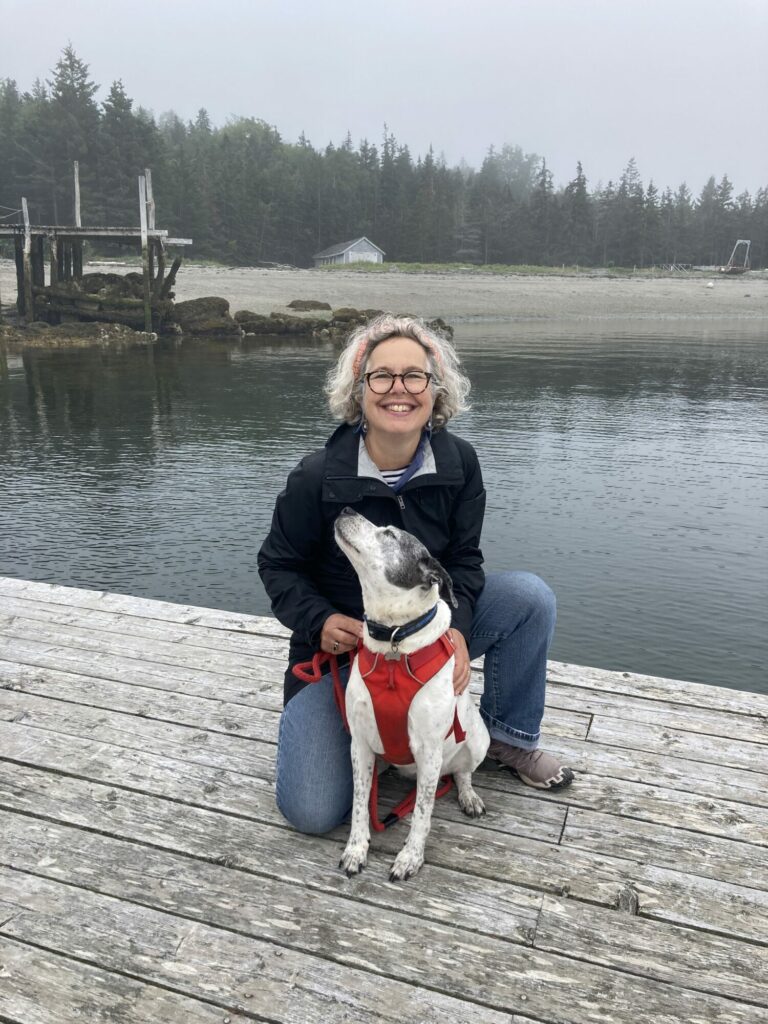
Phoebe Zerwick, off the coast of Deer Isle Maine
After 15 years at Wake, Phoebe Zerwick has retired as Director of Journalism.
Professor Zerwick started here in 2010 and served as Journalism Director from 2016-2025. While many of us know her as a teacher, she is foremost a journalist and champion of free expression. She moved to Winston-Salem in the 1980s to work as a reporter for The Winston-Salem Journal, where she stayed for 21 years covering the criminal justice system, public health, City Hall and much else. She wrote an 8-part series about the Darryl Hunt case that was published in November 2002 in The Journal. That series directly led to Hunt’s exoneration. After Hunt’s death, she wrote a book on the subject, the award-winning Beyond Innocence: The Life Sentence of Darryl Hunt. With her friend and colleague Mark Rabil in the Law School, she created the popular course Investigating Innocence, which she will continue to co-teach as an adjunct with Professor Rabil.
Learn more about Professor Zerwick’s writings and career at her website.
Below are three personal accounts of Professor Zerwick – the first by Professor Emeritus in English Anne Boyle; the second by Hu Womack, Instruction & Graduate Student Support Librarian in ZSR Library, and the last by Ivan Weiss, Director of Journalism. These remarks were delivered at Professor Zerwick’s retirement celebration on April 2, 2025.
••
I am delighted to be here this afternoon to celebrate my wonderful colleague and dear friend, Phoebe Zerwick.
Before she applied for a position in the Writing and Journalism programs, I had three prior encounters with Phoebe.
When I moved to Winston-Salem in the 80’s, I was an avid reader of The Winston-Salem Journal. The newspaper wasn’t the quick read it is today, but, often, I had to read it on the quick. On these days, I looked first for Phoebe’s byline, knowing how much I appreciated her point of view and the engaging clarity of her prose. More importantly perhaps, I valued her writing because she provided me with an introduction to important issues in my new community. This is one of the things valued journalists do—they help you to understand the issues facing the community. From Phoebe’s long articles, I learned about such topics as infant mortality, race lines in Winston-Salem, the tobacco settlement, and so much more. I was drawn to her focus on social justice, her ability to connect with her audience by anticipating their questions, and the clarity of her style.
My second encounter surprised me. I always wondered what Phoebe looked like and I was stunned to see a huge billboard downtown—before the curve on I-40 was straightened—with her picture on it, larger than life. So distracted I was, I almost ran off the road.
Then, I saw her in person. It was at her present home, but she didn’t live there at that time. We had mutual friends, Sally Shumaker, who worked with my husband, and Sally’s partner, Phil Hammon, who was visiting faculty in our Chemistry Department. Although I am such an introvert, I had to introduce myself and gush over what I fan I was. I was starry-eyed, but Phoebe left me quickly, perhaps to find wine or a more interesting conversation.
When Phoebe applied for the position in Writing and Journalism at Wake, I was excited. I knew her writing was truthful and engaging, that she researched deeply and well, and that she understood the importance of audience. But I wondered about her teaching skills. When I asked Phoebe about teaching, she was, as always, honest and clear. No, she had little to no experience. So I asked about mentoring—same answer. Building a writing program was so important, we didn’t want to make any mistakes. What we wanted were faculty who were passionate about writers and passionate about teaching mostly first-year students.
But we took the chance, and I will always assert that Phoebe is and was the best recruit we could have wished for—a stellar, intelligent, and compassionate teacher of journalism students and first-year students—but not at first. It was other characteristics that made Phoebe that great teacher—she has a great desire to do well, and, more than that, a desire to honestly assess and follow up on how to achieve success.
This is my memory of what happened. In her first semester, Phoebe did not receive stellar evaluations. After I read them, I was going to schedule a meeting. The English Department Chair had read them, as had the Director of Journalism, and they told me we needed to talk.
Before I could set up a meeting, Phoebe was at my door, telling me, “My students think my teaching sucks.”
We sat down and did the old count and categorize: The majority of students did not think her teaching sucked. We created categories: 1) Students asserted her standards were too high; 2) Students thought she pushed them into situations that were often uncomfortable; 3) Students felt they weren’t given helpful feedback.
Then, Phoebe’s problem-solving mode and her honesty came to the surface. Yes, she had expected a great deal of her students, and Phoebe took over the meeting and discussed how she would address each issue. She decided to hold conferences so she could give students feedback in person, questioning them on the choices they made, and giving them a sense of what options they could choose in future assignments. When she realized that students felt uncomfortable interviewing faculty or community members—even one another—she implemented role playing and addressed this, too, during conferences. The high standards issue was the one she was least able to resolve, until she realized that her students were new at this and learning. She kept those high standards, but reserved them for the end of the semester. She began working on assignment design that would allow students to learn how to meet those high standards over the course of the semester.
She volunteered to teach Writing 105, a class for many students who were less prepared for academic writing and who had major time commitments. Few volunteer to teach 105—but Phoebe did and did it well—though I suspect she volunteered because she wanted to work with Ryan Shirey, Director of the Writing Center.
Phoebe was the recipient of the Sam Gladding Award for her marvelous book, Beyond Innocence: The Life Sentence of Darly Hunt, but she should have received the teaching award.
I can say so many things, but want to leave you with three.
- Since her first year as faculty, Phoebe has been an active participant in the Writing Program Planning Committee and her service and point of view has been invaluable. You can always count on her to cut through disciplinary jargon and ask, What does that mean? How does it work? How do you know it works. She kept us safe from navel-gazing and pushed us forward in practical and imaginative ways. She is always undaunted.
- While doing this, she published her nationally renowned book, Beyond Innocence—and researched it so well. She talked to me about the prisons she visited, so she could understand not only Hunt’s experience, but how we treat those caught up in the prison/industrial complex. She published all over the place, The New York Times, The Washington Post, Glamour, local media. She is exactly what we wanted—a woman passionate about writing and passionate about teaching all students.
- She is a generous friend and colleague.
Still starry-eyed, I wish to thank Phoebe for joining us and helping to create strong programs in writing and journalism.
Anne Boyle, Professor Emeritus of English
••
First, I should never have volunteered to follow such eloquent speakers! What was I thinking?
Being a diligent librarian, I traced my first email from Phoebe to October 12, 2010, when Dr. Anne Boyle recommended that Phoebe reach out to me looking for equipment to support her advanced journalism class! And from the beginning of my interactions with Phoebe, it was clear she was creating rigorous and engaging projects for her students.
By 2014, Phoebe was bringing me into her FYS class “Writing Justice” to ensure these students could research their topics thoroughly, finding evidence-based peer-reviewed articles to support their research question. In these classes, I saw Phoebe’s commitment to robust and rigorous teaching and her deep concern and care for her students.
Later, in 2020, during Covid, Phoebe was one of the first faculty for whom I created an online research tutorial module so her students would still learn about the research resources they needed! And when “Beyond Innocence: The Life Sentence of Darryl Hunt” was published, I was once again in awe of Phoebe’s talent and commitment to journalism and truth-telling.
And all of that was before I seized the official role of library liaison to the Journalism program in the summer of 2022.
Even now, just last week, Phoebe hosted a panel discussion on Journalism today that included a wide array of journalists and support folks like me in attendance, helping us find ways to manage a rapidly changing landscape. Phoebe never slows down, and I marvel at this and appreciate it so much!
Phoebe, I see today as the beginning of a new chapter where we will all continue to be impressed by your commitment to journalism! Thank you for always inspiring me!
Hu Womack, Associate Librarian at ZSR Library
••
When I first met Phoebe Zerwick back in 2016, I was… not a different person exactly, but in a very different stage of my life. I was newly married, renting a house in Durham that you might politely call “bohemian.” Life was ephemeral. I definitely wasn’t thinking a lot about the future. I was hustling as an independent filmmaker, not knowing what I’d be doing one month or day to the next.
But then came one of those chance opportunities that in retrospect seems like fate. I was randomly forwarded a job posting for an adjunct position in Wake Forest’s Journalism Program. I thought, Why not apply, see what happens…
It’s uncanny to think that almost 10 years later, I’m here. Winston is home. I’m deeply entrenched in the community. I’ve met so many lovely, fascinating people. Sure, there’s some blood on the tracks… I’ve survived multiple tree fallings in my backyard, a lightning strike, a house fire caused by my beagle Albee, the whirlwind of my two daughters… It’s been great. It’s been bonkers. And Phoebe Zerwick has been right at the center of it.
I remember being in Durham Regional Hospital when my daughter Ruby was born in the fall of 2017, and getting an email from Phoebe about a permanent job opening in the Journalism Program. Baby in one hand, phone in the other, I asked my wife Stephanie, Should I apply? What direction do we want to go in as a family? What would this mean for us? It was a pivotal moment personally, and there was Phoebe.
This gets at a quality of Phoebe’s that I have come to know and appreciate. It’s a little complicated to explain. On the one hand there is Phoebe the investigative journalist – tough as nails… Well perhaps that’s hyperbole, and a bit cliche and inexact. How to say this – you want to really know your stuff when you talk with Phoebe, because one way or another you’re going to get to the truth of the matter. She has a devotion to the truth, it’s a tremendous quality, and it can be thrilling going alongside her in the process, one step after another, methodically, till you finally get there. It’s not just that she’s not afraid to ask difficult questions, it’s that the act of questioning, pulling away the veil, showing what’s really happening, who’s affected, how they’re feeling… that’s the Phoebe MO. It’s in her blood.
Being with Phoebe is so refreshing because there’s no pretense. To me, that’s true journalism, it’s not geared only to publishing a particular article or following a story, it’s more than that. It’s a way of seeing the world, a rigor of looking, of scrutiny, and a devotion. Phoebe is a journalist in that deep sense, always curious and learning, pushing the boundaries, always willing to speak her mind and heart, no matter whether that has to do with the larger happenings in politics, the ins and outs of the Journalism Program, advice for OG&B editors, or much more. It doesn’t matter the topic, it’s gonna be real, and it’s going to be inquisitive.
The flip side of that coin is that Phoebe truly cares for people. She has this big, beating heart. I saw this in the way she worked with the OG&B editors as their faculty advisor. Her devotion was more than just a sense of responsibility. It was a deep-seated belief that the students need to be free to report and speak their minds, and that they need support and encouragement in a world that can be cagey and closed and hostile.
I saw it, too, in her commitment to adjunct faculty. It’s incredibly important to her that everyone feels appreciated, integral, a part of the team, that they don’t just show up and teach and go home, that we’re building a network together, forming relationships for the long term.
I saw this in practice in a palpable way just last week, when Phoebe organized a lunch with faculty and local journalists about reporting in the age of Trump. At a time when reporting can be a lonely and dangerous endeavor, just having a space to come together, share experiences, concerns and ideas, to look one another in the eye… it was moving to watch and be a part of, and I’m sure people got a lot out of it.
Phoebe has been a close mentor to me the past eight years – generous with her time and knowledge, open and transparent about the decisions she was making in the Journalism Program, taking the time to talk me through problems, backing me up in the very, very rare occasion that I screwed up, supporting me in being a better teacher, encouraging me to experiment and develop new classes.
Beyond mentorship, we’ve clocked some real time together, Phoebe and I – navigating through the pandemic, the death of George Floyd, the #MeToo movement, the protests last spring, the election, whatever it is that’s going on now – intense, transformational times for all of us, confusing times, but perhaps uniquely so in a journalism program. What exactly journalism is, where it is, how it is, its value… all this is up in the air, a shifting fog, impossible to get a clear picture of.
That’s how it seems to me, at least, but I actually don’t know if that’s how it seems to Phoebe. There are core aspects, fundamentals, of being a journalist, that the times don’t change – that’s one of the biggest lessons I’ve learned from Phoebe. Maybe this is wishful thinking, but I like to believe that, amid all the uncertainty, Phoebe gets it, sees it all clearly, or at least soon will, through methodical questioning, research, devotion, and passion.
Maybe that’s part of the reason I’m sad to see her go. I’ll miss her clarity and fortitude, her power and her heart. I’ll miss her being here. I think we need what she has to offer more than ever.
At the same time, I’m excited for you, Phoebe. I admire that you’re starting a new chapter, have new adventures ahead of you, and thrilled that you’re keeping a toe here at Wake, staying part of the community you’ve been so formative in building.
Your legacy at Wake is large – for the Journalism Program, the university as a whole, your students, and for me.
Ivan Weiss, Director of Journalism