Written as part of an internship with the Center for Folklife and Cultural Heritage this summer, Journalism minor Hope Zhu’s (’25) article, “A Menominee Father-Son Duo Find Their Voices in Music,” was recently published by Smithsonian Folklife Festival. Below are her thoughts and what she learned from the process of writing her first magazine-style story:
I spent three months interning with Smithsonian Folklife until this summer, and I was eager to attend their annual festival. I’ve always had a strong interest in Indigenous issues and am an avid cultural festival attendee. After talking with my editor, I was assigned to cover two artists, including Wade Fernandez, an Indigenous musician from the Menominee Nation in Wisconsin. I had never written about a professional musician before (the piece I did earlier on the Chinese ensemble was my first arts and culture work), but I’ve always had a keen ear for folk music. Listening to Wade’s music before the festival, I was drawn in by the ethereal sound of his flute, combined with a modern take on blues—a genre I’d only recently started to appreciate, with its playful, offbeat humor. At the festival, his performance felt deeply spiritual, with references to ancestors and nature, and a message that we are all children of Mother Earth. It resonated with me, and I wanted my article to capture the same depth and flow. I also found the relationship between Wade and his son Quintin, a percussionist my age, particularly touching. Wade spoke of him with both respect and fatherly pride. The themes of nature and their shared journey to find their voices became the heart of my piece.
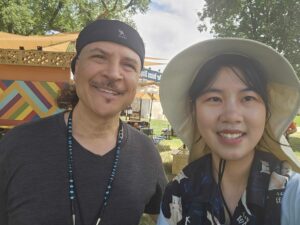
Wade Fernandez (left) and Hope Zhu (right)
One of the most important takeaways came during my interview with Wade, where he shared his struggles with low self-esteem, something I connected with. As I mentioned in my piece, he’s afraid of singing because he doesn’t feel good enough. But as we talked, and as he performed, Wade realized that music isn’t about him—it’s about offering something people can enjoy, a gift. Now, whenever I face a challenging project—whether it’s the complex magazine article I’m working on for Professor Yeoman’s class or election coverage I’m still trying to wrap my head around—I think of how Wade came to see his singing as something to give, not a way to prove himself. His generosity in sharing came from a love of self-expression, and I’m trying to embrace that approach when I write. I’ve realized that by just showing up, fact-checking, diving deep into research, and showing compassion during interviews, I can create something meaningful for my readers. When I’m still figuring out the language I’ll use for this kind of story, I want to thank Professor Barry Yeoman for his inspiring art and culture coverage, which gave me a model for how a good profile can speak to both the artist and their craft. I also want to thank the journalism department for approving the funds that made my trip to D.C. possible. Stay tuned for my next piece on an Inuit soul band at the Smithsonian Folklife Festival!