
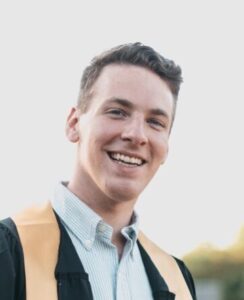
 This summer, Christian Green ’19 had an internship with Working Narratives – “a non-partisan social justice organization dedicated to challenging injustice by empowering communities to address issues that affect their lives.” The Journalism Program believes experiences like this are essential for developing journalists, and was proud to provide stipends to Christian and other Wake students to support their work beyond Wake’s campuses.
As part of the internship, Green produced “The Living History of Core Sound Decoys.” “Hunters and carvers along the Core Sound have been hand-carving wooden duck decoys for well over a century. In this episode, three members of the Core Sound Decoy Carver’s Guild on Harkers Island walk us through the history of that tradition, how it has changed, and what it can teach us about how culture moves.”
Christian reflects on his internship and future journalism plans below.
Going into the internship, I was very unsure of what to expect and how it would play out for my career goals. It was my first time ever working extensively in audio, my first experience working with a nonprofit and reporting from a social justice lens, all of my stories needed to be about the North Carolina coast while I was stuck in Raleigh, and I was assigned to cover the Arts beat despite having a background in science – so all kinds of new experiences during this unprecedented time. Despite all those uncertainties, the program ended up feeling much more natural than I initially imagined it might.
This internship covered the launch of an array of new podcasts for Shoresides.org, a Working Narratives project. This was exciting for me because I listen to a lot of podcasts and I think a lot about storytelling – not just the content but also the form, the structure, style and voice behind the story. Because my Arts beat team (me, two other interns, and an editor who works for Shoresides) was launching a new podcast, we first had the opportunity to create a name, a logo, and discuss not only what stories we wanted to tell, but also the ways we wanted to approach them and how we wanted them to sound.
After establishing the ideas behind our show and learning some basics of remote audio recording and editing in Adobe Audition, we began pitching stories, conducting interviews, and pulling them together into short pieces. In my mind, every story I wanted to tell could have been some 30-to-45 minute This American Life style episode where listeners really get to sit with a character and I get to unpack big, universal ideas. I quickly learned that, just like any other media, the amount of work that goes into each minute of an audio story is massive and I was not going to be able to dive straight into these epic longform stories like I imagined.
So instead, I started small. My first five stories were mostly 5 to 8 minute episodes where I turned a conversation with a single person into a quick, digestible nugget of a story. Those were actually very helpful for teaching me how to condense my ideas into the most simple and easily understood story and I realized you don’t need an hour to get an interesting point across, but I still found myself wanting to test out a more longform structure. In the course of reporting another story, I was told that duck decoy culture on the coast was huge and, after doing some research, I realized that this story felt like it had all the pieces I needed to make something a bit bigger.
Duck decoys had history, they were art but also functional tools, they were an integral part of a local culture, and the people who made them were also typically very interesting characters and natural storytellers. So I identified and spoke with four different carvers and spent around a month in total writing and recording narration, pulling in the best tape I had and turning the story of duck decoys into this bigger question of what constitutes tradition and how cultures change and morph over time.
I want any story I create to do two things simultaneously: Educate the reader/listener, teach them something new, give them some big idea to chew on; and also I want my story itself to feel like a piece of art, I want it to be a bit beautiful and captivating and fun to engage with. I think this duck decoy piece is, so far, my best approximation at doing both things well. I hope to continue building on what I learned here so I can keep doing it better and better.
I couldn’t have made this story or any others without a lot of help – so I give credit to my internship leaders Sarah Sloan and Laura Bratton as well as the Working Narratives director Nick Szuberla for offering me the platform. Shoresides, as a young organization, and Somewhere & Elsewhere, as a brand new podcast, gave me a lot of freedoms to pursue stories I was interested in and I can’t thank them enough for giving me the room to experiment with different kinds of stories so that I could land on this one.
Future Plans
This fall, Christian was supposed to serve as the International Program Assistant for Wake Forest’s Global AWAKEnings program in Denmark, but was unable to due to the pandemic. He is currently working as a freelance multimedia journalist, and pursuing new opportunities. His personal Soundcloud story list can be found here, and you can find Somewhere & Elsewhere here or on your podcasting app of choice (some are his stories, while some are produced by the other interns on his team). Additional work is available at his website: https://www.christiangreeen.