
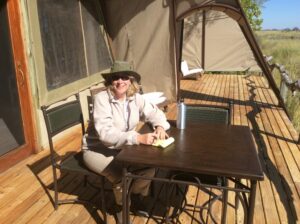
Maria Henson in Botswana
Maria Henson is many things – a twice Pulitzer Prize-winning journalist, a member of the WFU Writers Hall of Fame, the editor of Wake Forest Magazine, where she served for 15 years before retiring July 4, 2025, among other roles and a long list of prizes. Most important from our perspective – she was a core faculty member of the Journalism Program. One of her most important contributions was helping develop one of our two core courses – JOU 270 News Literacy – which has left a deep impact on the Program and countless students.
We will miss Professor Henson, but are thrilled she will continue teaching as an adjunct faculty member for the foreseeable future.
The following remarks were written and delivered by Phoebe Zerwick, former director of the Journalism Program, at the end-of-year celebration in May 2025, on the eve of Wake’s undergraduate graduation ceremony.
••
Welcome graduating journalism minors and their families, former and continuing Journalism students, and our small but mighty journalism faculty. For those of you who don’t know me, I am Phoebe Zerwick, the director of the Journalism Program at Wake Forest, at least through the end of June, when I will retire and Ivan Weiss takes on that role. We have a lot to celebrate today, and I have a few things I want to say, so please bear with me.
Most importantly, we have 27 journalism students graduating tomorrow and many of you are here this afternoon. I know how proud your professors are of all the deep reporting and storytelling you have produced with them over the last two or three years. Longform magazine articles on first-time homebuyers and the legacy of black cemeteries. Environmental stories on community gardens and food deserts. Investigative stories that probed the last execution in North Carolina. An advocacy film about refugee resettlement. And those of you who write and edit the OG&B, tireless reporting on a year of turmoil on our campus over the Israel Gaza war. Congratulations.
Many of your professors are here today, and for the parents I want to give you a brief explanation of how journalism education works at Wake Forest. We are a small interdisciplinary program, with three permanent faculty members, a core group of North Carolina based journalists who teach one or two courses a semester, and faculty from other departments whose courses in such subjects as art history, filmmaking, philosophy and law count as electives in the minor. Those of you who teach in the journalism program please stand up or wave your hand. I hope the parents here will take some time to get to know you.
We are also here to celebrate two retirements in the journalism program. I mentioned mine, but I have been sufficiently celebrated, or I should say roasted, at a campus gathering last month. I want to tell you a little bit about my friend and colleague Maria Henson, who is retiring on July 4 – an auspicious date – from her role as associate vice president and editor at large with responsibility for the Wake Forest Magazine, which she has turned into a gorgeous award-winning magazine.
We’re both retiring, but I prefer to think that we are graduating into the next unknown chapter.
Maria returned to her alma mater in 2010, the year I also started teaching in the Writing Program. We had mutual friends who told me about her. I was excited to meet her but also a little awestruck by her career, which included working for the legendary John Caroll at the Lexington Herald Leader, where she won a Pulitzer Prize for an extraordinary series of editorials on domestic violence. She was all of 31 or 32. She moved on to the Sacramento Bee, where she won a second Pulitzer Prize for editing a series on Yosemite National Park. She then took a year’s sabbatical, traveling on her own to Botswana before landing at Wake Forest. When she negotiated for her job running the magazine, she insisted that she would also teach one journalism course.
She and I both started teaching in the fall of 2010 and bonded right away as we tried to figure out how to turn our careers in reporting into coherent teaching. I could talk about the challenge, but I’m going to be real here and call it what it was: terror. It’s one thing to write a story on deadline. Interview a governor. Or tobacco executive. Or prosecutor. Quite another to sit at a seminar table with 16 to 18 expectant Wake Forest students and keep a discussion going for 75 minutes.
Maria’s course in the history of journalism quickly evolved into a course in News Literacy, which is now one of the core requirements in the journalism minor. Quite simply, the course examines the principles of truthful, verified, independent and accountable journalism, its role in a free society and how to tell it apart from all the other drivel that fills up all our social media feeds, whether that’s propaganda, advertising, or deliberate disinformation designed to undermine our faith in what is real.
During that first semester, I didn’t feel I could confide in any of my colleagues in the English Department. But Maria and I could commiserate. I remember Maria sending excerpts from final essays in her class about the significance of the First Amendment and how thrilling it was to have changed the way students understood what we now call the media landscape.
Education in news literacy has always felt important. But when we first started 15 years ago, when I was still teaching first-year writing, it never occurred to me that free speech – a free press, academic freedom, the First Amendment – would require protection. This was the United States, after all. A beacon of freedom.
I’ll be interested to hear what our commencement speaker Scott Pelley, of 60 Minutes, has to say tomorrow. CBS, as we know, has been sued by the Trump administration over its editing of an interview with Kamala Harris. Bill Owens, the longtime executive producer of 60 minutes, resigned last month as CBS was beginning negotiations to settle that lawsuit. It remains to be seen whether the network and its owner will cave.
But plenty of other news organizations are running scared. So are universities.
Our journalism students understand well what’s at stake.
In an OG&B editorial last month, No the Media Is Not Lying to You, Virginia Noone (’25), wrote an eloquent defense of the free press titled:
“The days after the election, I met two of my friends for lunch. It was like a poorly written joke: “A Harris voter, a Trump voter and a non-voter walk into the dining hall…”
We all started cautiously discussing the results of the election and which specific political issues informed our decisions. The sad punchline was this: we couldn’t even agree on the facts surrounding the issues.”
She went on to make a strong case for education in news literacy, the kind of course Maria pioneered, and which forms the core of journalism education at Wake Forest.
Please join me in congratulating Maria on her retirement, our faculty for teaching the practice of truthful, verified, independent and accountable journalism, and our graduating seniors who head into the world. A handful of you are going for jobs in journalism, but the rest I know will be informed citizens and fearless champions of free speech and an independent press.
Phoebe Zerwick, Former Director of Journalism